Top 8 Tips You Should Follow for a Perfect Start in Jiu Jitsu
Top 8 Tips You Should Follow for a Perfect Start in Jiu Jitsu
Feb 12, 2026
Table of Contents
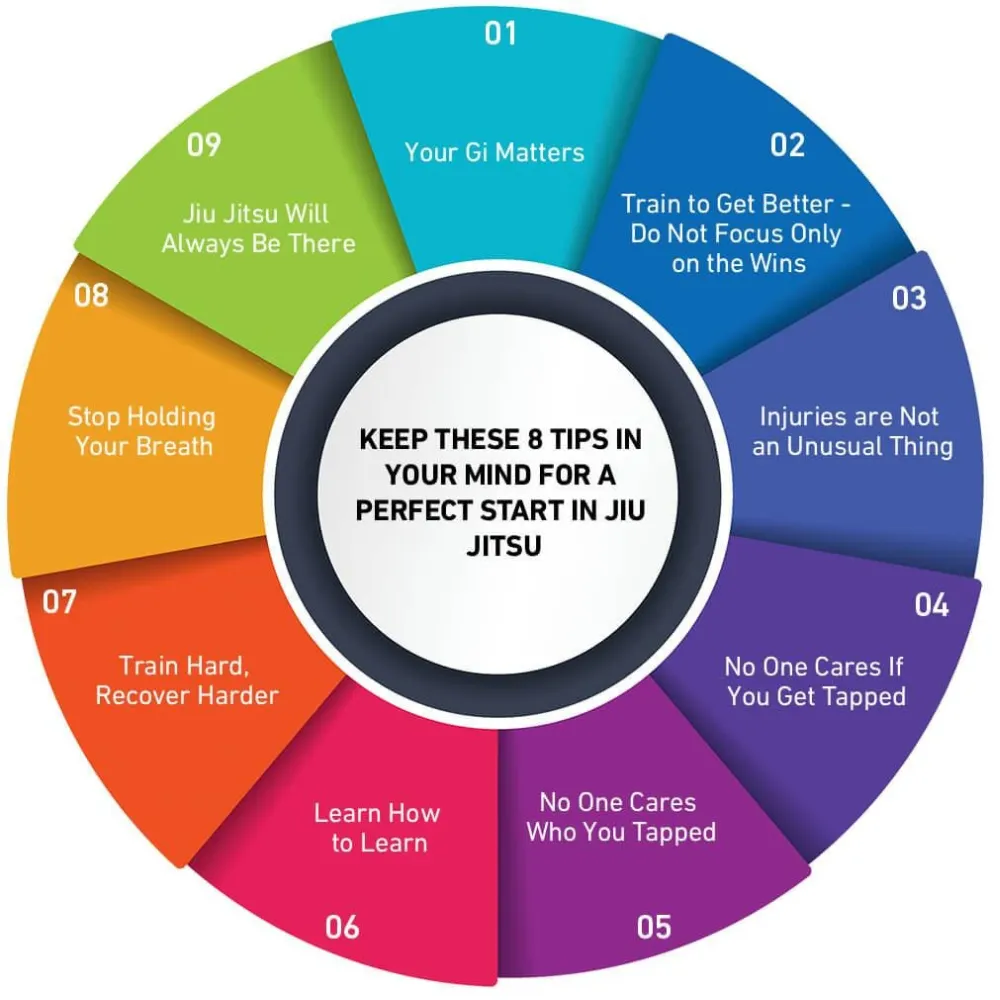
30 Second Summary - Keep These 8 Tips in Your Mind for a Perfect Start in Jiu Jitsu
1. Top 8 Tips for a Perfect Start in Your Jiu Jitsu Career
1.1 Your Gi Matters
1.2 Train to Get Better - Do Not Focus Only on the Wins
1.3 Injuries are Not an Unusual Thing
1.4 No One Cares If You Get Tapped
1.5 No One Cares Who You Tapped
1.6 Learn How to Learn
1.7 Train Hard, Recover Harder
1.8 Stop Holding Your Breath
1.9 Jiu Jitsu Will Always Be There
30 Second Summary - Keep These 8 Tips in Your Mind for a Perfect Start in Jiu Jitsu
The best tips you can give to yourself when you are starting Jiu Jitsu are train to get better - do not focus only on the wins, injuries are not an unusual thing, no one cares if you get tapped, no one cares who you tapped, learn how to learn, train hard, recover harder, stop holding your breath, and Jiu Jitsu will always be there.
1. Top 8 Tips for a Perfect Start in Your Jiu Jitsu Career
Grapplers make many mistakes when they are starting Jiu Jitsu, but with these tips, you can have a perfect start in your Jiu Jitsu journey:
1.1 Your Gi Matters
Grapplers, when starting, often ignore the importance of Jiu Jitsu Gi. Remember that your Gi size, fitness, quality, and color all have direct or indirect effects on your grappling performance, from slight to significant. So you should consider buying a high-quality Gi before starting BJJ training.
1.2 Train to Get Better - Do Not Focus Only on the Wins
- The first tip is don't train to win, train to get better. When you go into each training session trying to win every sparring round, you subconsciously start avoiding failure, and when you start avoiding failure, you end up avoiding the learning as well. You see, failure is part of the learning process; you try something new.
- Chances are you're going to fail, so you go back to the drawing board, brainstorm what you can do better next time, and try, try again. If you go into every training session with the sole purpose of winning, it narrows your focus to what you already know. It doesn't really encourage you to try new things or improve your game, because you're only focusing on what you know works. That can ultimately hold you back from making progress in Jiu Jitsu.
- So train without the extreme focus on just trying to win, but on finding ways to help you get better. If you focus on going into every training session with the intention of getting better for that session and stacking those sessions over the weeks and the months of the years of training on the mat, you are going to see some incredible progress, and you're going to make massive gains in your overall grappling ability.
1.3 Injuries are Not an Unusual Thing
- Injuries are going to happen, and you are responsible for keeping yourself safe. Jiu Jitsu is a combat Sport and injuries are going to happen. It's not about whether they will happen. It's only a matter of time before they happen. Now, there's nothing that you can do to completely prevent injury from happening, but there sure is a bunch of stuff that you can do to drastically decrease your risk of injury from happening.
- The biggest thing that you can do to decrease the risk of injury on the mat is to get stronger, because remember, no one ever got injured because they were too strong. The number one thing you can do off the mat to improve your performance and decrease the risk of injury on the mat is to get stronger.
- When you get stronger, you strengthen your muscles, ligaments, and tendons, and you improve your body's ability to absorb and withstand force. So you are building yourself to be more resilient and better handle the stressors you experience as a grappling athlete on the mat.
- The next thing that you can do to drastically decrease your risk of injury on the mat is just to train with trustworthy training partners. Now, this next tip for reducing the risk of injury may seem obvious, but it's worth repeating: tap early and tap often.
1.4 No One Cares If You Get Tapped
- No one cares if you get tapped in training by a lower belt. Nobody is driving home thinking about how you got tapped by a lower belt in training that day or even by an upper belt. If you are training every day to get better, chances are you'll be tapping out a lot as you try new things. You may come across failure where you do get caught in a submission, and that's totally okay.
- Just be mature enough to realize we are all just training to get better. Everyone gets tapped by upper belts. Everyone, at one point or another, has been tapped by a lower belt, but no one cares, and you shouldn't either.
1.5 No One Cares Who You Tapped
- The fourth tip is that no one cares who you tapped in training. Nobody is thinking about or keeping track of who you tapped out in training, and the first time you tap out an upper belt feels amazing. It seriously doesn't matter; you never know what someone else is going through before that training session.
- An upper belt, like a brown or black belt, might come in and do a training session, and maybe you are a young blue or purple belt, and you submit to them. You don't know what they were doing late or earlier that day. You don't know if they just did a workout, are training for a marathon, or are just doing Jiu Jitsu for fun on the side.
- You don't know if they are coming off an injury, and they are being really conservative to keep themselves healthy and avoid re-aggravating it. You don't know whether they're trying something new, following tip number one and training to get better, or trying something completely new. Maybe you catch them, and you end up submitting them.
- That's great, it honestly doesn't matter; no one cares if you get tapped out. No one cares who you tap out, and if you are an upper belt and you do get tapped by a lower belt, you are going to be pretty thankful that no one cares that you got tapped by a lower belt, because it happens to everybody.
1.6 Learn How to Learn
- The fifth tip is to learn how you learn. Experiment with different activities, such as watching videos, reading books, or rolling under an instructor's supervision. Use an ecological approach and constraint-based games to help structure your own training. This will really help to skyrocket your submission grappling skills. Do a lot of live rolling with specific focuses and intentions on working on specific skills.
- So instead of showing up to Jiu Jitsu and doing 100 reps of a knee cut or an arm bar, you should do live training. It will almost look like positional training, but it's a little different: you start in a specific position and have a single goal or focus to build the parts that make an armbar effective.
- Or you might be focusing only on separating the elbow from the body, or you might start in a certain position and focus only on controlling the shoulder. Then, as you start to progress, start piecing those things together. So you may start in a certain position and work through all the steps. Control the shoulder, separate the elbow from the body, apply downward pressure to the mat, and use some of those constraint-based games.
1.7 Train Hard, Recover Harder
- The sixth tip is very important and is a common point most grapplers ignore completely. They keep their focus on training, learning new techniques, and improving their skills. They do not prefer to recover on their own, which increases the risk of injury.
- Train hard and recover harder. Remember, it's not about what you do in the gym or on the mat that leads to progress. It's about what you do and can recover from. It's important to recognize that just because the class schedule at your Jiu Jitsu school has 12 sessions a week, you don't need to go to all 12 of those sessions, especially if your body can't recover from all the work that you are doing.
- There are three things I suggest you focus on to improve your recovery as a grappling athlete. These three things include dialing in your sleep, nutrition, and training schedule. If you lock in those three areas over the next 30 days, you will feel way better. You are going to be very surprised at how quickly you start to see progress and improvements in your grappling skills.
1.8 Stop Holding Your Breath
- If you are starting in Jiu Jitsu and feel like you are gassing out a lot during training, then it is probably because you are holding your breath (tensing up). It's really hard not to do that when you are just beginning in BJJ. It's intense and hard because people are squishing you, grabbing your neck, and twisting your arms and legs all over the place. So it's natural for you to tense up, try to stay tight, and keep everything safe.
- However, if you do that, you will gas out much faster. It may be hard to focus right now, but try to focus on breathing in and out of your nose as much as possible during live sparring. Not only will this be a more efficient way to breathe, but it can also help you relax a little. It will also prolong the point at which you gas out as a grappling athlete. Whether you want to say it's an immediate increase in conditioning or just being more efficient, it doesn't really matter.
1.9 Jiu Jitsu Will Always Be There
- The last tip is that Jiu Jitsu will always be there in your life. It is going to get busy, with different seasons when your schedule is busy and others when it is a little bit relaxed. This means that during that period of your life, you may not be able to maintain training twice a day, every single day of the week, or whatever heavy Jiu Jitsu schedule you had.
- You can enjoy training in BJJ as much as you want when you are single and have no kids. But once you have family to take responsibility for, you might not have enough time to give to Jiu Jitsu, and that is really fine. You don’t need to worry about it. Just keep in mind that Jiu Jitsu is always going to be there.
- There are going to be seasons of life where you can do more Jiu Jitsu training, and there are going to be seasons of life where you do less Jiu Jitsu training, and Jiu Jitsu is always going to be there, so don't think negatively about it.
Keep These 8 Tips in Your Mind for a Perfect Start in Jiu Jitsu.